What families should know about kratom, 7-OH, nitazenes, and a new generation of synthetic opioids
CRI-Help | November 16, 2026
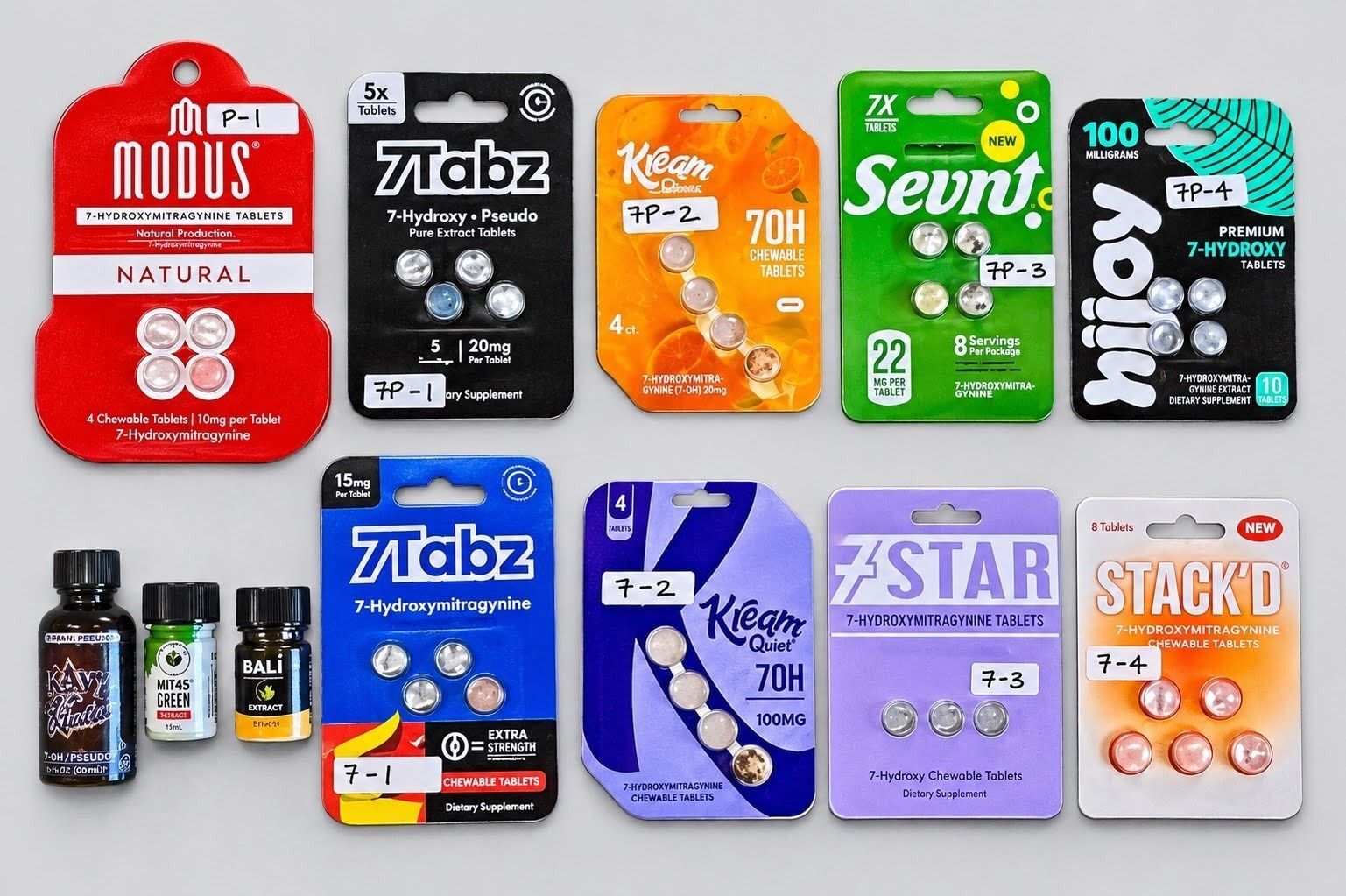
Photo Courtesy: U.S. Food and Drug Administration
A brightly packaged shot sits on a store shelf next to the energy drinks. A pill that looks like a familiar prescription changes hands at a party. Neither looks like the opioid crisis most of us picture, but both can contain powerful opioids, and the person taking them may have no idea.
Fentanyl has dominated headlines for years. Now highly concentrated products derived from kratom have turned up in everyday retail settings, while newer synthetic opioids are appearing in counterfeit pills and other illicit drugs. Some can cause life-threatening overdoses.
These substances aren't all the same. What connects them is a troubling combination of opioid activity, unpredictable potency, and gaps in public awareness. Understanding the differences can help families recognize risks, respond to emergencies, and seek treatment.
Kratom: When a "Natural" Product Acts Like an Opioid
Kratom comes from a tree native to Southeast Asia. Its leaves contain compounds, including mitragynine, that interact with opioid receptors. People may encounter kratom marketed for energy, relaxation, discomfort, or as an alternative to other substances. But "plant-based" does not automatically mean safe or nonaddictive.
A November 2 New York Times report described how kratom products are marketed through gyms, athlete sponsorships, podcasts, and social media, sometimes creating the impression that they're safe wellness products. Yet people interviewed for the story described escalating use, dependence, and withdrawal. For families, it's a reminder that a product marketed as a supplement or alcohol alternative can still carry serious risks.
Traditional kratom leaf is different from concentrated extracts and products containing enhanced levels of 7-hydroxymitragynine, commonly called 7-OH. The FDA warns that 7-OH products, sold as tablets, gummies, drink mixes, and shots, can be potent opioid products that have not been proven safe or effective for any use. The agency distinguishes these enhanced products from natural kratom leaf, while also warning about risks associated with kratom itself.
For some people, use begins as an attempt to manage chronic pain or symptoms of opioid withdrawal. But repeated use of concentrated products can lead to tolerance, cravings, and physical dependence. Someone who initially sought relief may find themselves taking increasingly frequent doses simply to avoid feeling sick.
The difference between traditional kratom and concentrated products matters, especially when consumers encounter them in familiar retail settings. Someone who sees a gummy or shot in a convenience store may assume it has been reviewed for safety. It may instead contain a concentrated substance capable of causing dependence, withdrawal, or serious adverse effects.
Regulators have started to respond. In October 2025, the California Department of Public Health warned that foods, dietary supplements, and drugs containing kratom or 7-OH are illegal to sell or manufacture in California, and state agents have since pulled thousands of products from store shelves. Federally, the Drug Enforcement Administration (DEA) temporarily placed three potent kratom-related compounds into Schedule I in August 2026. The agency subsequently proposed restrictions on products containing concentrated levels of 7-OH and mitragynine pseudoindoxyl, while distinguishing them from botanical kratom containing trace amounts. These actions reflect growing concern about highly potent products, but potentially dangerous products may still be available.
Nitazenes: Powerful Opioids People May Take Without Knowing
Nitazenes are a family of laboratory-made opioids first researched decades ago. They are chemically distinct from fentanyl, but some nitazene compounds can match or exceed fentanyl's potency. The DEA has documented nitazenes in counterfeit pills and in mixtures containing other drugs, including fentanyl, heroin, and cocaine.
The danger is not limited to people intentionally seeking opioids. A pill sold as a familiar medication may contain an entirely different substance. Because illicitly manufactured drugs have no reliable quality control, a person cannot determine their contents or strength from appearance alone.
Orphines: Another Emerging Synthetic Opioid Family
Orphines are another class of synthetic opioids, separate from both fentanyl and nitazenes. Examples include brorphine and newer compounds such as cychlorphine. International drug-monitoring authorities have reported growing detections of orphine analogues, including in drug seizures and fatal overdose investigations.
Researchers are still learning how often these compounds appear and how their effects vary. The important message for families is that the illicit drug supply can change faster than familiar drug names, routine screening methods, and public warnings.
Why Detection Can Be Difficult
A routine hospital urine drug screen does not necessarily test for kratom compounds, nitazenes, or orphines. A negative result on a standard panel therefore cannot rule out exposure. Specialized laboratory testing may be needed, and clinicians must rely on symptoms and the circumstances of an exposure rather than waiting for a routine test to identify the substance.
Likewise, a fentanyl test strip is not an all-purpose safety check. The United Nations Office on Drugs and Crime reports that orphines are not detected by fentanyl or nitazene test strips. A negative strip result does not establish that a drug is safe.
Warning Signs Families Can Watch For
Kratom and 7-OH use can be easy to miss, especially when the products look like supplements or snacks. Signs worth paying attention to include:
- Products labeled "7-OH," "kratom shots," "extract tablets," or "mitragynine," often in small bottles or gummy packs
- Use that started occasionally and has become daily, or doses that keep increasing
- Withdrawal symptoms when someone runs out or tries to stop, such as restlessness, muscle aches, irritability, trouble sleeping, runny nose, or stomach upset
- Spending more money or time getting the products, or becoming anxious when they aren't available
Counterfeit pills are harder to spot. Any pill that didn't come directly from a pharmacy should be treated as potentially dangerous, no matter how familiar it looks.
Recognizing an Overdose and What to Do
An opioid overdose can cause slow, shallow, or stopped breathing; inability to wake up; blue or gray lips or fingernails; and unusual snoring or gurgling sounds. Treat these signs as an emergency, regardless of what substance someone believes they took. Call 911 immediately. Give naloxone (Narcan) if available and follow the product instructions. If breathing does not improve, additional doses may be needed; follow dispatcher instructions and provide rescue breathing or CPR as directed. Stay with the person until emergency responders arrive. Even if naloxone appears to work, emergency medical evaluation is essential because breathing problems can return.
Naloxone can reverse the opioid component of an overdose involving these substances. The possibility of needing repeated doses is a reason to act quickly, not a reason to assume naloxone will not help.
The CDC has also warned about medetomidine, a non-opioid veterinary sedative found in illicit fentanyl. Naloxone cannot reverse its effects, making emergency medical care essential even after naloxone is given.
Dependence Is Treatable
A person using kratom concentrates or synthetic opioids may develop dependence and experience withdrawal when trying to stop. That can be frightening, particularly when the product was first marketed as a supplement or a way to manage discomfort.
Treatment does not have to begin with judgment or shame. A qualified medical team can assess substance use, withdrawal symptoms, other health conditions, and appropriate levels of care.
Medications such as buprenorphine or methadone may be considered in some cases, together with counseling and ongoing recovery support. Although medications are approved for opioid use disorder, none are currently FDA-approved specifically for kratom use disorder. Treatment decisions should be individualized based on each person's clinical needs.
How CRI-Help Can Help
Recognizing the problem is an important first step. Knowing where to turn is the next.
CRI-Help offers medically supported withdrawal management, residential and outpatient treatment, and medication-assisted treatment (MAT) for opioid use disorder, including dependence on kratom products and synthetic opioids. For people who aren't ready to commit to treatment, our 24/7 drop-in Lincoln Heights Sobering Center offers a safe place to stabilize and connect with staff, with no appointment needed.
"The drug supply is constantly changing, and both illicit and legal drug suppliers are getting sneakier with how products are marketed," says Dayna Dewitt Mataisz, director of nursing at CRI-Help. "At CRI-Help, we do our best to stay ahead by keeping up with research, talking with other addiction medicine specialists, and sharing what we learn as a team. We want our clients to understand what they may be taking and the risks involved, because their safety comes first."
What Families Should Remember
The next phase of the opioid crisis may not look like the last one. Risks can appear in brightly marketed retail products as well as counterfeit pills and unpredictable street-drug mixtures. Talk openly about what is being used, don't assume a product is safe because it is sold in a store, and take signs of overdose seriously. Keep naloxone accessible when opioid exposure is possible.
If you or someone you love is struggling with kratom, 7-OH, or another substance, CRI-Help can help you understand your options. Our team can assess your needs and help identify an appropriate path to treatment and recovery. It's OK to ask for help.
Sources
Background: Dr. Elizabeth Johnson, Sacramento County, "The New Wave: Managing Kratom, 7-OH, and Emerging Substances," lecture at the California Society of Addiction Medicine (CSAM) 2026 Annual Conference, October 22, 2026.
FDA, "Products Containing 7-OH Can Cause Serious Harm"
FDA, "FDA Takes Steps to Restrict 7-OH Opioid Products"
California Department of Public Health, letter on kratom and 7-OH products
DEA, 2025 National Drug Threat Assessment
UNODC, February 2026 advisory on nitazene and orphine analogues
The New York Times, reporting on kratom wellness marketing and addiction (November 2, 2026)